Python
Strengths and weaknesses of Python
Di, 06/06/2017 - 07:49 — Draketoa reply I wrote on quora.
Python is easy to learn and low ceremony. Both are pretty hard targets to hit. It also has great libraries for scientific work, for system scripting and for web development — and for most everything else. And it is pragmatic in a sense: It gets stuff done. And in a way which others can typically understand easily. Which is an even harder target to hit, especially with low ceremony languages.
- Login to post comments
- Weiterlesen
minimal Python script
Di, 06/06/2017 - 07:41 — DraketoOver the years I found a few things which in my opinion are essential for any Python script:
- A description,
- useful logging
- argument parsing and
- doctests
Everything in this setup is low-overhead and available from Python 2.6 to 3.x, so you can use it to start any kind of project.
- Login to post comments
- Weiterlesen
pyFreenet 0.4.1 with auto-spawn support in fcpupload
Do, 08/25/2016 - 22:36 — DraketoI just put up a new pyFreenet release (github):
If you have Python3 and pip >= 8 you can get it with pip3 install -U --user --egg pyFreenet3. It provides a cleaned up fcpupload script with --spawn support (requires GNU/Linux):
pip3 install -U --user --egg pyFreenet3
echo 1 > testfile
fcpupload --spawn --fcpPort 9486 testfile
- Login to post comments
- Weiterlesen
Why Python 3?
Do, 06/09/2016 - 07:06 — DraketoAt the Institute we use both Python 2 and Python 3. While researching the current differences (Python 3.5, compared to Python 2.7), I found two beautiful articles by Brett Cannon, the current manager of Python, and summarized them for my work group.
The articles:
- Why Python 3: Why Python3 exists
- Why use 3: How to pitch Python 3 to Management
The relevant points for us1 are the following:
-
I have summarized them because I can not expect scientists (or other people who only use Python) to read the full articles, just to decide what they do when they get the channce to tackle a new project. ↩
- Login to post comments
- Weiterlesen
Which language is best, C, C++, Python or Java?
Sa, 06/04/2016 - 18:38 — DraketoMy answer to the question about the best language on Quora. If you continue reading from here, please stick with me to the end. Ready to read to the end? Enjoy the ride!
My current answer is: Scheme ☺ It gives me a large degree of freedom to explore ways to program which were much harder hard to explore in Python, C++ and Java. That’s why I’m currently switching from Python to Scheme.1
But depending on my current step on the road to improve my skills2 and the development group and project, that answer might have been any other language — C, C++, Java, Python, Fortran, R, Ruby, Haskell, Go, Rust, Clojure, ….
-
Apprenticeship Patterns — Guidance for the Aspiring Software Craftsman ↩
- Login to post comments
- Weiterlesen
Warum Python3?
So, 04/10/2016 - 16:44 — DraketoIm Institut verwenden wir sowohl Python 2 als auch Python 3. Bei Recherche zu den aktuellen Unterschieden (Python 3.5 im Vergleich mit Python 2.7) habe ich zwei schöne Artikel von Brett Cannon gefunden, dem aktuellen Verwalter von Python, und sie für meine Arbeitsgruppe zusammengefasst.
Die Artikel:
- Warum Python 3: Why Python 3 exists
- Warum 3 nutzen: How to pitch Python 3 to Management
Die für uns relevanten1 Punkte sind:
-
Ich habe sie zusammengefasst, da ich nicht erwarten kann, dass Wissenschaftler (oder andere Leute, die Python nur verwenden) die ganzen Artikel lesen, nur um zu überlegen, was sie machen, wenn sie mal wieder ein neues Projekt angehen wollen. ↩
- Login to post comments
- Weiterlesen
Python chooses Github, therefore I’m releasing the py2guile PDF for free
Mi, 01/06/2016 - 23:54 — Draketo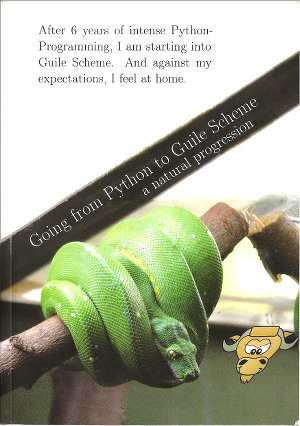
Python is the first language I loved. I dreamt in Python, I planned in Python, I thought I would never need anything else.
Download “Python to Guile” (pdf)
You can read more about this on the Mercurial mailing list.
- Free: html | pdf
preview edition
(complete)
Yes, this means that with Guile I will contribute to a language developed via Git, but it won’t be using a proprietary platform.
- Login to post comments
- Weiterlesen
Translating a lookup-dictionary to bash: Much simpler than I thought
Mi, 10/21/2015 - 18:18 — DraketoI wanted to name Transcom Regions in my plots by passing their names to the command-line tool, but I only had their region-number and a lookup dictionary in Python. To avoid tampering with the tool, I needed to translate the dictionary to a bash function, and thanks to the case statement it was much simpler than I had expected.
This is the original dictionary:
- Login to post comments
- Weiterlesen
Gratis py2guile from Freenet
Sa, 10/17/2015 - 12:04 — Draketopy2guile is a book I wrote about Python and Guile Scheme. It’s selling at 14.95 € for the printed softcover.
To fight the new german data retention laws, you can get the ebook gratis: Just install Hyphanet, then the following links work:
Escape total surveillance and get an ebook about the official GNU extension language for free today!
- Login to post comments
Going from Python to Guile Scheme - a natural progression
Do, 10/01/2015 - 21:42 — DraketoPython is the first language I loved. I dreamt in Python, I planned in Python, I thought I would never need anything else.
- Free: html | pdf
- Softcover: 14.95 €
with pdf, epub, mobi
- Source: download
free licensed under GPL
- Login to post comments
- Weiterlesen
Freenet Communication Primitives: Part 2, Service Discovery and Communication
Do, 08/20/2015 - 19:42 — DraketoBasic building blocks for communication in Freenet.
This is a guide to using Freenet as backend for communication solutions - suitable for anything from filesharing over chat up to decentrally hosted game content like level-data. It uses the Python interface to Freenet for its examples.

This guide consists of several installments: Part 1 is about exchanging data, Part 2 is about confidential communication and finding people and services without drowning in spam and Part 3 ties it all together by harnessing existing plugins which already include all the hard work which distinguishes a quick hack from a real-world system (this is currently a work in progress, implemented in babcom_cli which provides real-world usable functionality).
Note: You need the current release of pyFreenet for the examples in this article (0.3.2). Get it from PyPI:
# with setuptools
easy_install --user --egg pyFreenet==0.4.0
# or pip
pip install --user --egg pyFreenet==0.4.0
This is part 2: Service Discovery and Communication. It shows how to find new people, build secure communication channels and create community forums. Back when I contributed to Gnutella, this was the holy grail of many p2p researchers (I still remember the service discovery papers). Here we’ll build it in 300 lines of Python.
Welcome to Freenet, where no one can watch you read!
- Login to post comments
- Weiterlesen
Freenet Communication Primitives: Part 1, Files and Sites
Sa, 07/18/2015 - 18:46 — DraketoBasic building blocks for communication in Freenet.
This is a guide to using Freenet as backend for communication solutions - suitable for anything from filesharing over chat up to decentrally hosted game content like level-data. It uses the Python interface to Freenet for its examples.

This guide consists of several installments: Part 1 (this text) is about exchanging data, Part 2 is about confidential communication and finding people and services without drowning in spam and Part 3 ties it all together by harnessing existing plugins which already include all the hard work which distinguishes a quick hack from a real-world system. Happy Hacking and welcome to Freenet, the forgotten cypherpunk paradise where no one can watch you read!
- Login to post comments
- Weiterlesen
Memory requirement of Python datastructures: numpy array, list of floats and inner array
Di, 12/16/2014 - 16:42 — DraketoEasily answering the question: “How much space does this need?”
Table of Contents
- Login to post comments
- Weiterlesen
Recursion wins!
Mi, 03/05/2014 - 21:36 — DraketoI recently read the little schemer and that got me thinking about recursion and loops.
After starting my programming life with Python, I normally use for-loops to solve problems. But actually they are an inferior mechanism when compared to recursion, if (and only if) the language provides proper syntactic support for that. Since that claim pretty much damns Python on a theoretical level (even though it is still a very good tool in practice and I still love it!), I want to share a simplified version of the code which made me realize this.
- Login to post comments
- Weiterlesen
Installing Scipy and PyNIO on a Bare Cluster with the Intel Compiler
Do, 09/26/2013 - 09:20 — Draketo2 years ago I had the task of running a python-program using scipy on our university cluster, using the Intel Compiler. I needed all those (as well as PyNIO and some other stuff) for running TM5 with the python shell on the HC3 of KIT.
This proved to be quite a bit more challenging than I had expected - but it was very interesting, too (and there I learned the basics of GNU autotools which still help me a lot).
But no one should have to go to the same effort with as little guidance as I had, so I decided to publish the script and the patches I created for installing everything we needed.1
The script worked 2 years ago, so you might have to fix some bits. I won’t promise that this contains everything you need to run the script - or that it won’t be broken when you install it. Actually I won’t promise anything at all, except that if the stuff here had been available 2 years ago, that could have saved me about 2 months of time (each of the patches here required quite some tracking of problems, experimenting and fixing, until it provided basic functionality - but actually I enjoyed doing that - I learned a lot - I just don’t want to be forced to do it again). Still, this stuff contains quite some hacks - even a few ugly ones. But it worked.
- Login to post comments
- Weiterlesen
Equal-Area Map Projections with Basemap and matplotlib/pylab
Di, 06/25/2013 - 17:23 — DraketoPlotting global equal area maps with python, matplotlib/pylab and Basemap.
Table of Contents
- Login to post comments
- Weiterlesen
wisp: Whitespace to Lisp
Di, 03/26/2013 - 05:00 — DraketoNew version: draketo.de/software/wisp
» I love the syntax of Python, but crave the simplicity and power of Lisp.«
display "Hello World!" ↦ (display "Hello World!")
define : factorial n     (define (factorial n)
    if : zero? n       ↦     (if (zero? n)
       . 1                      1
       * n : factorial {n - 1}  (* n (factorial {n - 1}))))
Wisp basics
- Wisp turns indentation into lisp expressions.
- Why Wisp?
- Get it
- from its Mercurial repository:
hg clone https://hg.sr.ht/~arnebab/wisp - Or via GNU Guix:
guix install guile guile-wisp - Or via the package guile-wisp-hg for Arch Linux.
- Or via
./configure; make installfrom the releases.
- from its Mercurial repository:
- See more examples and tests.
»ArneBab's alternate sexp syntax is best I've seen; pythonesque, hides parens but keeps power« — Christopher Webber in twitter, in identi.ca and in his blog: Wisp: Lisp, minus the parentheses
♡ wow ♡
»Wisp allows people to see code how Lispers perceive it. Its structure becomes apparent.« — Ricardo Wurmus in IRC, paraphrasing the wisp statement from his talk at FOSDEM 2019 about Guix for reproducible science in HPC.
☺ Yay! ☺
with (open-file "with.w" "r") as port
     format #t "~a\n" : read port
Familiar with-statement in 25 lines.
Update (2020-09-15): Wisp 1.0.3 provides a
wispbinary to start a wisp repl or run wisp files, builds with Guile 3, and moved to sourcehut for libre hosting: hg.sr.ht/~arnebab/wisp.
After installation, just runwispto enter a wisp-shell (REPL).
This release also ships wisp-mode 0.2.6 (fewer autoloads), ob-wisp 0.1 (initial support for org-babel), and additional examples. New auxiliary projects include wispserve for experiments with streaming and download-mesh via Guile and wisp in conf:conf new -l wisp PROJNAMEcreates an autotools project with wisp whileconf new -l wisp-enter PROJAMEcreates a project with natural script writing and guile doctests set up. Both also install a script to run your project with minimal start time: I see 25ms to 130ms for hello world (36ms on average). The name of the script is the name of your project.
For more info about Wisp 1.0.3, see the NEWS file.
To test wisp v1.0.3, install Guile 2.0.11 or later and bootstrap wisp:wget https://www.draketo.de/files/wisp-1.0.3.tar_.gz;
tar xf wisp-1.0.3.tar_.gz ; cd wisp-1.0.3/;
./configure; make check;
examples/newbase60.w 123If it prints 23 (123 in NewBase60), your wisp is fully operational.
If you have additional questions, see the Frequently asked Questions (FAQ) and chat in #guile at freenode.
That’s it - have fun with wisp syntax!
Update (2019-07-16): wisp-mode 0.2.5 now provides proper indentation support in Emacs: Tab increases indentation and cycles back to zero. Shift-tab decreases indentation via previously defined indentation levels. Return preserves the indentation level (hit tab twice to go to zero indentation).
Update (2019-06-16): In c programming the uncommon way, specifically c-indent, tantalum is experimenting with combining wisp and sph-sc, which compiles scheme-like s-expressions to c. The result is a program written like this:pre-include "stdio.h" define (main argc argv) : int int char** declare i int printf "the number of arguments is %d\n" argc for : (set i 0) (< i argc) (set+ i 1) printf "arg %d is %s\n" (+ i 1) (array-get argv i) return 0 ;; code-snippet under GPLv3+To me that looks so close to C that it took me a moment to realize that it isn’t just using a parser which allows omitting some special syntax of C, but actually an implementation of a C-generator in Scheme (similar in spirit to cython, which generates C from Python), which results in code that looks like a more regular version of C without superfluous parens. Wisp really completes the round-trip from C over Scheme to something that looks like C but has all the regularity of Scheme, because all things considered, the code example is regular wisp-code. And it is awesome to see tantalum take up the tool I created and use it to experiment with ways to program that I never even imagined! ♡
TLDR: tantalum uses wisp for code that looks like C and compiles to C but has the regularity of Scheme!
Update (2019-06-02): The repository at https://www.draketo.de/proj/wisp/ is stale at the moment, because the staticsite extension I use to update it was broken by API changes and I currently don’t have the time to fix it. Therefore until I get it fixed, the canonical repository for wisp is https://bitbucket.org/ArneBab/wisp/. I’m sorry for that. I would prefer to self-host it again, but the time to read up what i have to adjust blocks that right now (typically the actual fix only needs a few lines). A pull-request which fixes the staticsite extension for modern Mercurial would be much appreciated!
Update (2019-02-08): wisp v1.0 released as announced at FOSDEM. Wisp the language is complete:display "Hello World!"
↦ (display "Hello World!")
And it achieves its goal:
“Wisp allows people to see code how Lispers perceive it. Its structure becomes apparent.” — Ricardo Wurmus at FOSDEM
Tooling, documentation, and porting of wisp are still work in progress, but before I go on, I want thank the people from the readable lisp project. Without our initial shared path, and without their encouragement, wisp would not be here today. Thank you! You’re awesome!
With this release it is time to put wisp to use. To start your own project, see the tutorial Starting a wisp project and the wisp tutorial. For more info, see the NEWS file. To test wisp v1.0, install Guile 2.0.11 or later and bootstrap wisp:
If it prints 23 (123 in NewBase60), your wisp is fully operational.wget https://bitbucket.org/ArneBab/wisp/downloads/wisp-1.0.tar.gz;
tar xf wisp-1.0.tar.gz ; cd wisp-1.0/;
./configure; make check;
examples/newbase60.w 123
If you have additional questions, see the Frequently asked Questions (FAQ) and chat in #guile at freenode.
That’s it - have fun with wisp syntax!
Update (2019-01-27): wisp v0.9.9.1 released which includes the emacs support files missed in v0.9.9, but excludes unnecessary files which increased the release size from 500k to 9 MiB (it's now back at about 500k). To start your own wisp-project, see the tutorial Starting a wisp project and the wisp tutorial. For more info, see the NEWS file. To test wisp v0.9.9.1, install Guile 2.0.11 or later and bootstrap wisp:
If it prints 23 (123 in NewBase60), your wisp is fully operational.wget https://bitbucket.org/ArneBab/wisp/downloads/wisp-0.9.9.1.tar.gz;
tar xf wisp-0.9.9.1.tar.gz ; cd wisp-0.9.9.1/;
./configure; make check;
examples/newbase60.w 123
That’s it - have fun with wisp syntax!
Update (2019-01-22): wisp v0.9.9 released with support for literal arrays in Guile (needed for doctests), example start times below 100ms, ob-wisp.el for emacs org-mode babel and work on examples: network, securepassword, and downloadmesh. To start your own wisp-project, see the tutorial Starting a wisp project and the wisp tutorial. For more info, see the NEWS file. To test wisp v0.9.9, install Guile 2.0.11 or later and bootstrap wisp:
If it prints 23 (123 in NewBase60), your wisp is fully operational.wget https://bitbucket.org/ArneBab/wisp/downloads/wisp-0.9.9.tar.gz;
tar xf wisp-0.9.9.tar.gz ; cd wisp-0.9.9/;
./configure; make check;
examples/newbase60.w 123
That’s it - have fun with wisp syntax!
Update (2018-06-26): There is now a wisp tutorial for beginning programmers: “In this tutorial you will learn to write programs with wisp. It requires no prior knowledge of programming.” — Learn to program with Wisp, published in With Guise and Guile
Update (2017-11-10): wisp v0.9.8 released with installation fixes (thanks to benq!). To start your own wisp-project, see the tutorial Starting a wisp project. For more info, see the NEWS file. To test wisp v0.9.8, install Guile 2.0.11 or later and bootstrap wisp:
If it prints 23 (123 in NewBase60), your wisp is fully operational.wget https://bitbucket.org/ArneBab/wisp/downloads/wisp-0.9.8.tar.gz;
tar xf wisp-0.9.8.tar.gz ; cd wisp-0.9.8/;
./configure; make check;
examples/newbase60.w 123
That’s it - have fun with wisp syntax!
Update (2017-10-17): wisp v0.9.7 released with bugfixes. To start your own wisp-project, see the tutorial Starting a wisp project. For more info, see the NEWS file. To test wisp v0.9.7, install Guile 2.0.11 or later and bootstrap wisp:
If it prints 23 (123 in NewBase60), your wisp is fully operational.wget https://bitbucket.org/ArneBab/wisp/downloads/wisp-0.9.7.tar.gz;
tar xf wisp-0.9.7.tar.gz ; cd wisp-0.9.7/;
./configure; make check;
examples/newbase60.w 123
That’s it - have fun with wisp syntax!
Update (2017-10-08): wisp v0.9.6 released with compatibility for tests on OSX and old autotools, installation toguile/site/(guile version)/language/wispfor cleaner installation, debugging and warning when using not yet defined lower indentation levels, and withwisp-scheme.scmmoved tolanguage/wisp.scm. This allows creating a wisp project by simply copyinglanguage/. A short tutorial for creating a wisp project is available at Starting a wisp project as part of With Guise and Guile. For more info, see the NEWS file. To test wisp v0.9.6, install Guile 2.0.11 or later and bootstrap wisp:
If it prints 23 (123 in NewBase60), your wisp is fully operational.wget https://bitbucket.org/ArneBab/wisp/downloads/wisp-0.9.6.tar.gz;
tar xf wisp-0.9.6.tar.gz ; cd wisp-0.9.6/;
./configure; make check;
examples/newbase60.w 123
That’s it - have fun with wisp syntax!
Update (2017-08-19): Thanks to tantalum, wisp is now available as package for Arch Linux: from the Arch User Repository (AUR) as guile-wisp-hg! Instructions for installing the package are provided on the AUR page in the Arch Linux wiki. Thank you, tantalum!
Update (2017-08-20): wisp v0.9.2 released with many additional examples including the proof-of-concept for a minimum ceremony dialog-based game duel.w and the datatype benchmarks in benchmark.w. For more info, see the NEWS file. To test it, install Guile 2.0.11 or later and bootstrap wisp:
If it prints 23 (123 in NewBase60), your wisp is fully operational.wget https://bitbucket.org/ArneBab/wisp/downloads/wisp-0.9.2.tar.gz;
tar xf wisp-0.9.2.tar.gz ; cd wisp-0.9.2/;
./configure; make check;
examples/newbase60.w 123
That’s it - have fun with wisp syntax!
Update (2017-03-18): I removed the link to Gozala’s wisp, because it was put in maintenance mode. Quite the opposite of Guile which is taking up speed and just released Guile version 2.2.0, fully compatible with wisp (though wisp helped to find and fix one compiler bug, which is something I’m really happy about ☺).
Update (2017-02-05): Allan C. Webber presented my talk Natural script writing with Guile in the Guile devroom at FOSDEM. The talk was awesome — and recorded! Enjoy Natural script writing with Guile by "pretend Arne" ☺
presentation (pdf, 16 slides) and its source (org).
Have fun with wisp syntax!
Update (2016-07-12): wisp v0.9.1 released with a fix for multiline strings and many additional examples. For more info, see the NEWS file. To test it, install Guile 2.0.11 or later and bootstrap wisp:
If it prints 23 (123 in NewBase60), your wisp is fully operational.wget https://bitbucket.org/ArneBab/wisp/downloads/wisp-0.9.1.tar.gz;
tar xf wisp-0.9.1.tar.gz ; cd wisp-0.9.1/;
./configure; make check;
examples/newbase60.w 123
That’s it - have fun with wisp syntax!
Update (2016-01-30): I presented Wisp in the Guile devroom at FOSDEM. The reception was unexpectedly positive — given some of the backlash the readable project got I expected an exceptionally sceptical audience, but people rather asked about ways to put Wisp to good use, for example in templates, whether it works in the REPL (yes, it does) and whether it could help people start into Scheme.The atmosphere in the Guile devroom was very constructive and friendly during all talks, and I’m happy I could meet the Hackers there in person. I’m definitely taking good memories with me. Sadly the video did not make it, but the schedule-page includes the presentation (pdf, 10 slides) and its source (org).Wisp is ”The power and simplicity of #lisp with the familiar syntax of #python” talk by @ArneBab #fosdem pic.twitter.com/TaGhIGruIU
— Jan Nieuwenhuizen (@JANieuwenhuizen) January 30, 2016
Have fun with wisp syntax!
Update (2016-01-04): Wisp is available in GNU Guix! Thanks to the package from Christopher Webber you can try Wisp easily on top of any distribution:
This already gives you Wisp at the REPL (take care to follow all instructions for installing Guix on top of another distro, especially the locales).guix package -i guile guile-wisp
guile --language=wisp
Have fun with wisp syntax!
Update (2015-10-01): wisp v0.9.0 released which no longer depends on Python for bootstrapping releases (but ./configure still asks for it — a fix for another day). And thanks to Christopher Webber there is now a patch to install wisp within GNU Guix. For more info, see the NEWS file. To test it, install Guile 2.0.11 or later and bootstrap wisp:
If it prints 23 (123 in NewBase60), your wisp is fully operational.wget https://bitbucket.org/ArneBab/wisp/downloads/wisp-0.9.0.tar.gz;
tar xf wisp-0.9.0.tar.gz ; cd wisp-0.9.0/;
./configure; make check;
examples/newbase60.w 123
That’s it - have fun with wisp syntax!
Update (2015-09-12): wisp v0.8.6 released with fixed macros in interpreted code, chunking by top-level forms,: .parsed as nothing, ending chunks with a trailing period, updated example evolve and added examples newbase60, cli, cholesky decomposition, closure and hoist in loop. For more info, see the NEWS file.To test it, install Guile 2.0.x or 2.2.x and Python 3 and bootstrap wisp:
If it prints 23 (123 in NewBase60), your wisp is fully operational.wget https://bitbucket.org/ArneBab/wisp/downloads/wisp-0.8.6.tar.gz;
tar xf wisp-0.8.6.tar.gz ; cd wisp-0.8.6/;
./configure; make check;
examples/newbase60.w 123
That’s it - have fun with wisp syntax! And a happy time together for the ones who merge their paths today ☺
Update (2015-04-10): wisp v0.8.3 released with line information in backtraces. For more info, see the NEWS file.To test it, install Guile 2.0.x or 2.2.x and Python 3 and bootstrap wisp:
If it prints 120120 (two times 120, the factorial of 5), your wisp is fully operational.wget https://bitbucket.org/ArneBab/wisp/downloads/wisp-0.8.3.tar.gz;
tar xf wisp-0.8.3.tar.gz ; cd wisp-0.8.3/;
./configure; make check;
guile -L . --language=wisp tests/factorial.w; echo
That’s it - have fun with wisp syntax!
Update (2015-03-18): wisp v0.8.2 released with reader bugfixes, new examples and an updated draft for SRFI 119 (wisp). For more info, see the NEWS file.To test it, install Guile 2.0.x or 2.2.x and Python 3 and bootstrap wisp:
If it prints 120120 (two times 120, the factorial of 5), your wisp is fully operational.wget https://bitbucket.org/ArneBab/wisp/downloads/wisp-0.8.2.tar.gz;
tar xf wisp-0.8.2.tar.gz ; cd wisp-0.8.2/;
./configure; make check;
guile -L . --language=wisp tests/factorial.w; echo
That’s it - have fun with wisp syntax!
Update (2015-02-03): The wisp SRFI just got into draft state: SRFI-119 — on its way to an official Scheme Request For Implementation!
Update (2014-11-19): wisp v0.8.1 released with reader bugfixes. To test it, install Guile 2.0.x and Python 3 and bootstrap wisp:
If it prints 120120 (two times 120, the factorial of 5), your wisp is fully operational.wget https://bitbucket.org/ArneBab/wisp/downloads/wisp-0.8.1.tar.gz;
tar xf wisp-0.8.1.tar.gz ; cd wisp-0.8.1/;
./configure; make check;
guile -L . --language=wisp tests/factorial.w; echo
That’s it - have fun with wisp syntax!
Update (2014-11-06): wisp v0.8.0 released! The new parser now passes the testsuite and wisp files can be executed directly. For more details, see the NEWS file. To test it, install Guile 2.0.x and bootstrap wisp:
If it prints 120120 (two times 120, the factorial of 5), your wisp is fully operational.wget https://bitbucket.org/ArneBab/wisp/downloads/wisp-0.8.0.tar.gz;
tar xf wisp-0.8.0.tar.gz ; cd wisp-0.8.0/;
./configure; make check;
guile -L . --language=wisp tests/factorial.w;
echo
That’s it - have fun with wisp syntax!
On a personal note: It’s mindboggling that I could get this far! This is actually a fully bootstrapped indentation sensitive programming language with all the power of Scheme underneath, and it’s a one-person when-my-wife-and-children-sleep sideproject. The extensibility of Guile is awesome!
Update (2014-10-17): wisp v0.6.6 has a new implementation of the parser which now uses the scheme read function. `wisp-scheme.w` parses directly to a scheme syntax-tree instead of a scheme file to be more suitable to an SRFI. For more details, see the NEWS file. To test it, install Guile 2.0.x and bootstrap wisp:
That’s it - have fun with wisp syntax at the REPL!wget https://bitbucket.org/ArneBab/wisp/downloads/wisp-0.6.6.tar.gz;
tar xf wisp-0.6.6.tar.gz; cd wisp-0.6.6;
./configure; make;
guile -L . --language=wisp
Caveat: It does not support the ' prefix yet (syntax point 4).
Update (2014-01-04): Resolved the name-clash together with Steve Purcell und Kris Jenkins: the javascript wisp-mode was renamed to wispjs-mode and wisp.el is called wisp-mode 0.1.5 again. It provides syntax highlighting for Emacs and minimal indentation support via tab. You can install it with `M-x package-install wisp-mode`
Update (2014-01-03): wisp-mode.el was renamed to wisp 0.1.4 to avoid a name clash with wisp-mode for the javascript-based wisp.
Update (2013-09-13): Wisp now has a REPL! Thanks go to GNU Guile and especially Mark Weaver, who guided me through the process (along with nalaginrut who answered my first clueless questions…).
To test the REPL, get the current code snapshot, unpack it, run./bootstrap.sh, start guile with$ guile -L .(requires guile 2.x) and enter,language wisp.
Example usage:then hit enter thrice.display "Hello World!\n"
Voilà, you have wisp at the REPL!
Caveeat: the wisp-parser is still experimental and contains known bugs. Use it for testing, but please do not rely on it for important stuff, yet.
Update (2013-09-10): wisp-guile.w can now parse itself! Bootstrapping: The magical feeling of seeing a language (dialect) grow up to live by itself:python3 wisp.py wisp-guile.w > 1 && guile 1 wisp-guile.w > 2 && guile 2 wisp-guile.w > 3 && diff 2 3. Starting today, wisp is implemented in wisp.
Update (2013-08-08): Wisp 0.3.1 released (Changelog).
Spaß mit import from in Python
Fr, 03/22/2013 - 16:09 — Draketo→ Antwort auf Is it in this case : http://identi.ca/url/75523035 (see : [01:16]1 — Julien-Claude Fagot, die eine Antwort war auf One more reason why you should not use “from bla import foo”: print __import__(obs.__class__.__module__).__file__ — ArneBab
Datei: bla.py
def foo():
    print "bla"
Interaktiver Test:
\>>> import bla
\>>> bla.foo()
bla
\>>> def fu():
...   print "fu"
...
\>>> fu()
fu
\>>> from bla import foo
\>>> foo()
bla
\>>> bla.foo = fu
\>>> bla.foo()
fu
\>>> foo()
bla
Profifrage: Was passiert, wenn du from bla import foo nach bla.foo = fu ausführst?
-
dsop: if you use 'bla.foo', then yes, you can assign to bla.foo and you'll see the change. If you do 'from bla import foo', then your locally imported 'foo' will not 'see' changes to bla.foo. ↩
- Login to post comments
- Weiterlesen
Iteratoren als Filter
Fr, 10/12/2012 - 03:11 — DraketoFür meine Plotroutinen brauche ich oft Funktionen, die eine Liste an Messwerten durchgehen und nur diejenigen zurückgeben, die einem bestimmten Kriterium entsprechen. Wenn dabei die Anzahl der Messwerte in die Millionen geht, kann alleine schon die Liste der ungefilterten Messwerte den Arbeitsspeicher des Rechners sprengen.
Ich könnte jetzt einfach eine Funktion schreiben, die alle Werte liest, filtert und nur die Relevanten zurückgibt.
Das könnte dann etwa so aussehen:
- Login to post comments
- Weiterlesen
Reducing the Python startup time
Di, 06/05/2012 - 09:47 — DraketoThe python startup time always nagged me (17-30ms) and I just searched again for a way to reduce it, when I found this:
The Python-Launcher caches GTK imports and forks new processes to reduce the startup time of python GUI programs.
Python-launcher does not solve my problem directly, but it points into an interesting direction: If you create a small daemon which you can contact via the shell to fork a new instance, you might be able to get rid of your startup time.
To get an example of the possibilities, downl
- Login to post comments
- Weiterlesen
Read your python module documentation from emacs
Do, 04/12/2012 - 19:42 — DraketoUpdate 2021: Fixed links that died with Bitbuckets hosting.
I just found the excellent pydoc-info mode for emacs from Jon Waltman. It allows me to hit C-h S in a python file and enter a module name to see the documentation right away.
- Login to post comments
- Weiterlesen
def censor_the_net()
Do, 01/19/2012 - 21:05 — Draketodef censor_the_net(): "wealth vs. democracy via media-control" try: SOPA() # see Stop Online Piracy Act except Protest: # see sopastrike.com try: PIPA() # see PROTECT IP Act except Protest: # see weak links try: OPEN() # see red herring except Protest: try: ACTA() # see Anti-Counterfeiting_Trade_Agreement except Protest: # see resignation⁽¹⁾, court, vote anyway and advise against try: CISPA() # see Stop the Online Spying Bill except Protest: # see Dangers try: CETA() # See Comprehensive Economic and Trade Agreement except Protest: # see ePetition 50705 try: TTIP() # See Transatlantic Trade and Investment Partnership except Protest: # see TTIP-Protest erreicht Brüssel and Wie wir TTIP gestoppt haben try: TISA() # See Secret Trade in Services Agreement (TISA) except Protest: # see Unter Ausschluss der Öffentlichkeit try: JEFTA() # See Wie TTIP und wieder hinter verschlossenen Türen except Protest: # see deep concern und TTIP auf Japanisch verhindern und Ein Kniefall vor Japan? und JEFTA Leaks try: Article11And13() # See Die Zensurmaschinen und das Leistungsschutzrecht kommen in die Zielgerade der EU-Gesetzgebung except Protest: # see Stop the censorship-machinery! Save the Internet! try: FreiwilligeRasterung() # See Mit Hashabgleich und TPM except Protest: # see nur für gute Menschen and „eine neue Zensursula-Kampagne“ and „Wenn Privatsphäre kriminalisiert wird, werden nur Kriminelle noch Privatsphäre haben.“ try: TERREG() # See TERREG-Verordnung except Protest: # see discord.savetheinternet and TERREG-Sharepics and Uploadfilter auf Steroiden and new online censorship powers try: Chatkontrolle() # See Nachrichtendurchleuchtung except Protest: # see KI Anzeige wegen Sexting and Wiretapping Children and Deutscher Anwaltsverein and Strategic autonomy in danger and Kinderschutzbund gegen anlasslose Scans verschlüsselter Nachrichten and droht unsere Strafverfolgung…lahmzulegen and das verdächtige Bild try: CETA_in_Gruen() # See Ratifizierung im Galopp except Protest: # see Ceta bleibt falsch and Zu wenig staatliche Kontrolle try: Danish_Chatkontrolle() # See Schattentreffen and Anwaltsverein warnt except Protest: # see Warum ist Chatkontrolle so gefährlich für uns alle? and Apothekenumschau and Forschende beklagen die Ignoranz try: Mandate_Voluntary_Control() # See Perfides Täuschungsmanöver except Protest: # See The public is being played for fools and Fight Chat Control Timeline if destroy_free_speech_and_computers(): # (english video) from __future__ import plutocracy
while wealth_breeds_wealth and wealth_gives_power: # (german text and english video) # see wealth vs. democracy via media-control (german) censor_the_net()
- Login to post comments
- Weiterlesen
pyRad is now in Gentoo portage! *happy*
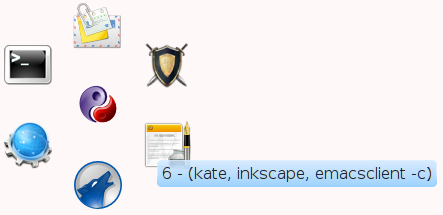
Mo, 07/18/2011 - 08:12 — DraketoMy wheel type command interface pyRad just got included in the official Gentoo portage-tree!
So now you can install it in Gentoo with a simple emerge kde-misc/pyrad.
- Login to post comments
- Weiterlesen
turn files with wikipedia syntax to html (simple python script using mediawiki api)
Fr, 10/29/2010 - 20:19 — DraketoI needed to convert a huge batch of mediawiki-files to html (had a 2010-03 copy of the now dead limewire wiki lying around). With a tip from RoanKattouw in #mediawiki@freenode.net I created a simple python script to convert arbitrary files from mediawiki syntax to html.
Usage:
- Download the script and install the dependencies (yaml and python 3).
- Login to post comments
- Weiterlesen
pyRad - a wheel type command interface for KDE
Do, 07/15/2010 - 20:45 — DraketoArrrrrr! Ye be replacin' th' walk th' plank alt-tab wi' th' keelhaulin' pirate wheel, matey! — Lacrocivious
pyRad is a wheel type command interface for KDE1, designed to appear below your mouse pointer at a gesture.
install | setup | usage and screenshots | download and sources

- Login to post comments
- Weiterlesen
pkgcore vs. eix → pix (find packages in Gentoo)
Fr, 06/25/2010 - 22:18 — DraketoFor a long time it bugged me, that eix uses a seperate database which I need to keep up to date. But no longer: With pkgcore as fast as it is today, I set up pquery to replace eix.
The result is pix:
alias pix='pquery --raw -nv --attr=keywords'
(put the above in your ~/.bashrc)
The output looks like this:
$ pix pkgcore
* sys-apps/pkgcore
versions: 0.5.11.6 0.5.11.7
installed: 0.5.11.7
repo: gentoo
description: pkgcore package manager
homepage: http://www.pkgcore.org
keywords: ~alpha ~amd64 ~arm ~hppa ~ia64 ~ppc ~ppc64 ~s390 ~sh ~sparc ~x86
- Login to post comments
- Weiterlesen
Spiele programmieren (Quellen)
Do, 07/30/2009 - 09:55 — DraketoDas hier ist eine kleine Auswahl an Quellen, um eigene Spiele zu programmieren. Sie ist nicht vollständig, sollte aber ausreichen, um direkt anfangen zu können. Sie enthält nur freie Programme.
Wenn du C++ programmieren kannst
- Horde3D: http://www.horde3d.org/
- Panda3D: http://www.panda3d.org/
- Ogre3D: http://www.ogre3d.org/
Wenn du Python programmieren kannst
- Soya3D (3D): http://www.lesfleursdunormal.fr/static/informatique/soya3d/index_en.html
- Pyglet (2D/3D): http://www.pyglet.org/
- Pygame (2D): http://www.pygame.org
- Bindings zu Horde3D, Panda3D und Ogre3D (s.o.) :)
- Lernen: http://wiki.python.org/moin/GameProgramming
Wenn du nicht programmieren kannst
- Login to post comments
- Weiterlesen
Mercurial vs. Bazaar speedtest clone and log - update: 4 runs with different versions
Mo, 12/15/2008 - 18:57 — DraketoSome folks in #mercurial @ freenode.net just repeated the tests, so we have now a bit more stable data.
The evaluation shows the following:
- Initial clone: hg is about 4.4 times faster (about 2 min vs. 6 to 15 min)
- Repository sizes: the hg repo is about 1.92 smaller (~113M vs. 215M)
- Time for a full log: hg is about 2.36 times faster (~21s vs. ~50s)
- Time for annotating Misc/NEWS: hg is 1.5 times slower than bzr.
Without the result from bzr-1.6.1 it is 2.6 times slower (~43s vs 17s). - Integrity checking: hg is by several orders of magnitude faster than bzr which just took too long - everyone stopped it after varying time (30s to 17 min), because the output spoke of hours remaining, one had an integrity error. hg needed about 1 min.
- Local clone: hg is 11 times faster (39s vs. 7.14 min).
Without the 1m15 result from the high disk load host it is 16 times faster (26s). - Local clone with hot filesystem: hg is 14.9 times faster (26s vs. 6.5 min).
- Hot copy of just .bzr / .hg: The speeds are about equal, so the difference doesn't come from raw filesystem speed (2s).
- Additional Bazaar tests to check shared repository cloning performance (you only get this when you use a shared repository and only clone that shared repository): With shared repository and hardlinks bzr only needs about 5 seconds for cloning.
Geschwindigkeitstest - zwei Arten des for loops über tuples
Di, 04/08/2008 - 13:04 — DraketoIch habe getestet, ob es einen Geschwindigkeitsunterschied zwischen zwei Arten des for loops über eine Liste von tuples gibt:
liste_von_tuples = [(1, 2), (3, 4), (5, 6)]
Es gibt 100.000 tuple, und jeder tuple enthält 2 Zufallszahlen.
Art 1:
for i in liste_von_tuples:
   res.append(i[1])
Art 2:
for i, j in liste_von_tuples:
   res.append(j)
- Login to post comments
- Weiterlesen
Versionsverwaltungen testen - Mercurial (hg) und Bazaar (bzr)
Do, 03/20/2008 - 10:52 — DraketoIch habe gerade einen sehr schönen Vergleich der Versionsverwaltungssysteme Mercurial und Bazaar gefunden.
Für alle, die sich nicht durch einen langen Artikel wühlen wolllen:
Mercurial ist in den meisten Tests 2-5x schneller als Bazaar.
Der volle Artikel:
http://sayspy.blogspot.com/2006/11/bazaar-vs-mercurial-unscientific.html
Falls ihr gerne eine Übersetzung der kritischen Teile hättet, schreibt es bitte.
- Login to post comments
- Weiterlesen

Diese Seite nutzt Cookies. Und Bilder. Manchmal auch Text. Eins davon muss ich wohl erwähnen — sagen die meisten anderen, und ich habe grade keine Zeit, Rechtstexte dazu zu lesen…
