English
The greenhouse effect, calculated again
Fr, 11/08/2019 - 23:41 — DraketoNew version: draketo.de/wissen/greenhouse-effect-calculated

I did not want to talk about the greenhouse effect without having checked the math and physics. Therefore I calculated it myself.
If you want all links to work, read the the PDF-version.
- Login to post comments
- Weiterlesen
What I need from IntelliJ and what I deeply miss when I’m not using Emacs
So, 10/27/2019 - 22:05 — DraketoUpdates will be written on my new site: draketo.de/software/intellij-emacs
Inhaltsverzeichnis
At work I’m using IntelliJ for Java development, but I’m not happy with the interface. It forces me out of my concentration and regularly breaks my flow by having stuff jump around and stealing focus.
But I cannot switch to something that works better for me, because there are features of IntelliJ that I require to work efficiently.
- Login to post comments
- Weiterlesen
Immutable function arguments and variables
Di, 07/16/2019 - 21:42 — Draketo- Dev A: “Fortran is totally outdated.”
- Dev B: “I wish we could declare objects in function arguments or variable values as immutable in Java and Javascript.”
Fortran developer silently weeps:
! immutable 2D array as argument in Fortran
  integer, intent(in) :: arg(:,:)
! constant value
  character(len=10), parameter :: numbers = "0123456789"
(yes, I’m currently reading a Javascript book)
- Login to post comments
- Weiterlesen
If one dozen people will stop eating beef, how much will this help to slow down global warming?
So, 06/30/2019 - 20:51 — DraketoIf one dozen people will stop eating beef, this will reduce the yearly global CO₂ emissions by around 48 tons CO₂-equivalent1 (about one quarter of their total emissions, and half their emissions from food).
-
For beef part of this CO₂-equivalent is due to methane which has a lifespan of only around 10 years, so the actual improvement isn’t as long-lasting as actually planting a forest: You won’t see much of ↩
- Login to post comments
- Weiterlesen
Equality and Prosperity go hand in hand
Mo, 06/17/2019 - 21:15 — DraketoA reply to the common argument for inequality:
Much better to focus on growing the economy than on increasing equality.
This is the old trickle down theory. Homeless people in the US could tell you that growing the economy without increasing equality does not help the poor. The reality is:
Increasing equality increases longterm growth of the economy.
The trickle-down theory goes against research results. Even the IMF has accepted that equality and prosperity aren’t opposites but rather go hand in hand: The higher the equality, the more sustained growth a country experiences (PDF).
- Login to post comments
- Weiterlesen
power and blindness: the tragedy behind systemd
Di, 04/23/2019 - 16:10 — Draketo→ comment to The Tragedy of systemd where Benno Rice said that he’s impressed by the way how systemd was spread into most GNU/Linux distributions and that systemd was a source of ideas for BSD.
Looking at the methods used to force distributions to adopt systemd, i.e. by adding hard dependencies in the biggest desktop environment or by bundling udev and continuously tightening the dependency from udev on systemd, that’s a form of power-play against the distributions. A dependency I really don’t want.
- Login to post comments
- Weiterlesen
Reproducible build of Freenet do-it-yourself: verify-build demystified
Di, 11/13/2018 - 21:19 — DraketoYou might know the reproducible-builds project, which tries to allow users to verify that what they install actually corresponds to the released source. Or GNU Guix, which provides transparent reproducible binaries — along with a challenge-function.
Given that Freenet is made for people with high expectations for integrity, it might not surprise you that Freenet has been providing a verifyable1 build and a verification script since 2012. However until release 1481, it was a hassle to set up, and few people used it.
But now that we’re on gradle, verifying that what I release is actually what’s tagged in the source is much easier than before.
The following instructions are for GNU/Linux, and maybe other *nixes, allowing you to verify the test release of 1482. You can easily adapt them for future releases.
-
Since Java puts timestamps into class files and requires signing of jars, the jar is not byte-by-byte reproducible, but the verify-build script unpacks the jar and compares the class-files, ensuring that they only differ in timestamps and similar that do not affect functionality. ↩
- Login to post comments
- Weiterlesen
The Hyphanet Web of Trust keeps communication friendly with actual anonymity
Di, 09/18/2018 - 21:19 — DraketoIn the past decade there hasn’t been a year without a politician calling for real names on the internet. Some even want to force people to use real photos as profile pictures. All in the name of stopping online hate, though enforcing real names has long been shown to actually make the problem worse.
This article presents another solution, one that has actually proven that it keeps communication friendly, even in the most anonymous environment of the fully decentralized Hyphanet project.
And that solution does work without enabling censorship and harassment (as requiring real names would).
- Login to post comments
- Weiterlesen
Copyright directive modal window for your website
Sa, 09/08/2018 - 17:07 — DraketoThe European Copyright directive threatens online communication in Europe. On September 12th the European parliament takes the crucial vote which can still fix it. But the parliamentarians (MEPs) need to hear our voices.
- Login to post comments
- Weiterlesen
Relicensing a project from GPLv2 or later to AGPLv3 or later
Do, 08/30/2018 - 21:13 — DraketoSwitching from GPLv2 or later to AGPL is perfectly legal. But if it is not your own project, it is often considered rude.
This does not relicense the original code, it just sets the license of new code and of the project as a whole.
- Login to post comments
- Weiterlesen
Please accept the signatures from the petition against Article 13
Mo, 07/02/2018 - 19:47 — DraketoDear Antonio Tajani,
Please accept the signatures from the petition against article 13.1
In 2014 I contributed to the Public Consultation on the review of the EU copyright rules.2
I publish music online, I write online, I publish Free Software, and I share links to news.
Last month I wrote to my representatives in JURI and asked them to preserve internet freedom. 15 of them nontheless voted to destroy online freedom. I cannot understand how they could vote for a system which will enforce the widespread establishment of technologies which can form the foundation for censorship which lets chinese censorship appear like a paradise of free speech.
Therefore I now beg you to accept the signatures from the petition against article 13.
Please let the voices of the European citizens be heard. Please help us preserve the Europe we love.
The best of wishes,
Dr. Arne Babenhauserheide
-
The petition against Article 13, currently with over 654,000 signatures: https://www.change.org/p/european-parliament-stop-the-censorship-machinery-save-the-internet ↩
-
My answers to the public consultation on copyright in the EU: http://www.draketo.de/files/2014-03-04-eu-copyright-consultation-document_en-arne_babenhauserheide.pdf ↩
- Login to post comments
You cannot afford 1% predators
So, 06/24/2018 - 18:18 — DraketoThe discussion about sexual assault at conferences has been going on for a few years now. Moral reasoning has been discussed a lot, and I will not repeat that.1
Here I will give a dispassionate, cold and calculating reason why your community cannot afford to tolerate 1% predators:
If in a community of 50 men and 50 women, one person is a predator who attacks one woman every year and causes her to leave, and every year either a man or a woman joins, the community will be male-only after 100 years.
Even 1% predators is far too much.
-
Just read the following twitter thread if you need a refresher on the moral issues: So I was at an academic conference this weekend and had to physically intervene to prevent a sexual assault by a male colleague on a female colleague who was drunk to the point that she was clearly not in control of herself, and unable to exercise judgment or consent. — Brad Simpson (@bradleyrsimpson) (June 22, 2018) ↩
- Login to post comments
- Weiterlesen
New Horizons for Science
Mi, 06/13/2018 - 21:42 — DraketoFarewell to friends -- and a love.
Download: mp3 audio | webm video; Watch on youtube
New recording 2019 at Intermezzo with Rika Körte and Steven Macdonald as recording engineers: mp3 audio
Goodbye my love, I leave tonight,
I know you’re in new hands,
Though I would rather follow you,
That’s not the way that this is planned,
Our destiny will now be watched
by different eyes than mine,
I wish you just the best,
be sure we’ll meet again in time.
- Login to post comments
- Weiterlesen
The princess is the ultimate representation of social and hierarchical power
Fr, 05/11/2018 - 21:17 — DraketoKnight, do my bidding.
A girl told my son “I’m a princess, you’re a knight, fetch me a glass of water!”. It was then that I realized that a princess typically isn’t someone to save. I was so proud of my son when he said “no”, because I suddenly realized how hard it is to escape the shackles of that special story.
A princess is the one person in the country, who reigns surpreme in both hierarchy and social standing. People in stories might hate the king, but the princess is beloved by most. Remember princess Diana.
- Login to post comments
- Weiterlesen
the zen of tolerance
Di, 04/24/2018 - 22:42 — Draketo- You are entitled to voice your opinion.
- You are not entitled to force it upon everyone.
- You are not entitled to force it upon a subgroup repeatedly.
- You are also not entitled to hurl hate towards participants, since that would disrupt communication.
- If you cannot stay respectful and friendly after being asked to, I will unsee you and advise others to do the same with a clear and brief explanation, so they can take an informed decision.
I will use technical means to realize the zen of tolerance.
Tolerance for intolerance is self-defeating. Continuous disruption of communication is censorship.
- Login to post comments
- Weiterlesen
A deterministic upper bound for the network load of the fully decentralized Freenet spam filter
Sa, 04/07/2018 - 12:22 — DraketoGoal: Improve the decentralized spam filter in Freenet (WoT) to have deterministic network load, bounded to a low, constant number of subscriptions and fetches.
This article provides calculations which show that decentralized spam filtering with privacy through pseudonyms can scale to communication systems that connect all of humanity. It is also applicable to other systems than Freenet, see use in other systems.
Inhaltsverzeichnis
Originally written as a comment to bug 3816. The bug report said "someone SHOULD do the math". I then did the math. Here I’m sharing the results.
Useful prior reading is Optimizing a distributed spam filter for Freenet.
This proposal has two parts:
- Ensuring an upper bound on the network cost, and
- Limiting the cost due to checking stale IDs.
- Login to post comments
- Weiterlesen
counting scientific publications as metric for scientific quality is dumb
So, 11/19/2017 - 11:35 — DraketoScientific institutions1 currently base a large part of their internal evaluation, their comparison to others, and their hiring decisions on counting publication (with a number of different scorings).
And this is dumb.
On the surface this causes pressure to publish as many papers as possible2 which drives down quality of publications to the lowest standard reviewers accept.3 And it strengthens a hierarchy of publishers, where some publications are worth more than others based on the name of the journal. That simplifies funding decisions. But makes them worse. And it creates an incentive to get a maximum of prestige with a minimum of substance.4
-
For this article scientific institutions mainly means those state-actors who finance scientists and those private actors who employ scientists and compete for state funding. ↩
-
The problem here is pressure to inflate the impact metrics of publications. Publishing should be about communicating research, not about boosting ones job opportunities. ↩
-
This argument is based on discussions I had with many other scientists over the years, along with experiences like seeing that people split publications into several papers to increase the publication count, even though that does not improve the publication itself. It is also based on the realization that few scientists I met were still following all publications in their sub-field. For a longer reasoning see information challenges in scientific communication. ↩
-
That said: While I did my PhD and postdoc in atmospheric physics (up until 2017), I worked with many scientists from several different countries, and every single one of them lived the idealism of scientific integrity and put it before the harmful incentives. So while some of the incentives over the past decades are a problem, they do not at present destroy the reliability of science in general. ↩
- Login to post comments
- Weiterlesen
Freenet Interview with Zilion
Do, 10/12/2017 - 21:42 — DraketoZilion Web conducted an Interview about Freenet with me. Zilion asked interesting questions and I kind of went overboard in answering them. They include:
- When did you become a freenet developer? Why?
- Freenet has 18 years of continuous development, from here to there, how do you see your growth?
- Frost vs. FMS, what is your choice and why?
- What do you think about people who use Freenet just for illegal purposes? And what is your concept of freedom about that?
- What to expect from the future in Freenet?
- Can you tell us how Opennet and Darknet works, and its pros and cons?
To see the answers, just head over to the article:
Interview with Freenet Developer (ArneBab)
https://zilionweb.wordpress.com/2017/08/07/interview-with-freenet-developer-arnebab/
And do install Freenet and then connect confidentially to your friends to build the darknet one friend at a time.
- Login to post comments
Two visions of our future
Fr, 09/01/2017 - 05:56 — Draketo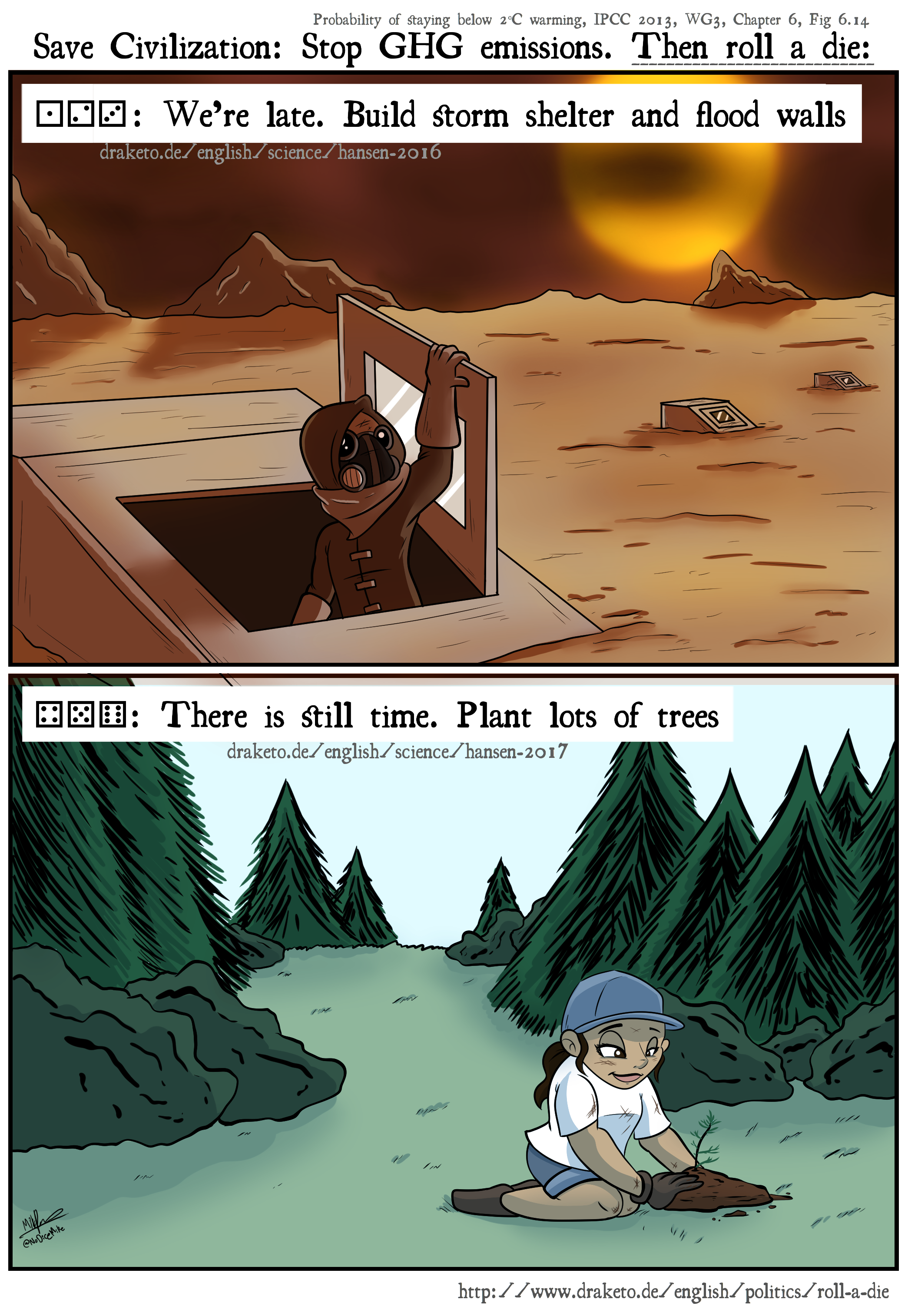
by Mike Perry (http://nodicemike.com)
We still have to stop CO₂ emissions and plant trees to prevent even worse catastrophes, but since 2022 the most likely future is that there will be catastrophes even if we stop CO₂ emissions right now. This is what climate scientists in the past 30 years hoped to prevent. We failed. Now we must fight to avoid even worse outcomes. We are making progress at that, but we must speed up.
Update 2022: As by the WMO, we’re now at 50% within the next 5 years: “⚀ or ⚁ or ⚂” (1 or 2 or 3). “The odds of at least one of the next 5 years temporarily reaching the Paris Agreement threshold of 1.5°C have increased to 50:50. In 2015 the chance was zero.”
Update (2021-09): According to IPCC AR6, we’re now at 50%.
Update 2018-09-03: As by Aengenheyster et al. 2018, we’re now at “⚀ or ⚁” (1 or 2): »However, reaching the 1.5 K target appears unlikely as MM would be required to start in 2018 for a probability of 67%.« MM means getting a 2% increase of the share of renewables every year.
I don’t know what we rolled, but I sure hope it’s not a 1.1
For the robust science behind the green future, see Hansen et al. 2017:
Young people's burden: requirement of negative CO₂ emissions.
-
Not every place will become this uninhabitable. But almost every place will have huge adaptation cost. See Hansen et al. 2016. Let’s hope we rolled a 2-6; and let’s stop ruining our odds. We need to go green. ↩
- Login to post comments
- Weiterlesen
Answers to “I can't use Freenet”
So, 07/30/2017 - 22:19 — DraketoShort answers to questions from a message in the anonymous Freenet Message System:
Ultra-short answer: Go to https://freenetproject.org/pages/download.html and run the installer. It’s fast and easy.
Now onward to the message:
psst@GdwO… wrote :
ArneBab@-jtT… wrote : Yes. And that’s one of the reasons why we need Freenet: to wrestle back control over our communication channel.
Good luck getting people to use it though.
Yes, that’s something we need to fix. And there’s a lot we can do for that. It’s just a lot of boring work.
Let’s go through your points and see which we could fix:
I can't use Freenet. It's illegal! It isn't? How do you know?
It’s created by a registered tax-exempt charity1, how can it be illegal?
-
The Freenet Project Inc is a 501(c)(3) non-profit organization, with the mission "to assist in developing and disseminating technological solutions to further the open and democratic distribution of information". It is registered under EIN 95-4864038. ↩
- Login to post comments
- Weiterlesen
Hansen 2017: Young people's burden: requirement of negative CO₂ emissions
Fr, 07/28/2017 - 09:25 — DraketoJames Hansen et al. published a paper about the expected costs due to climate change, aptly named "Young people's burden".
→ Young people's burden: requirement of negative CO2 emissions
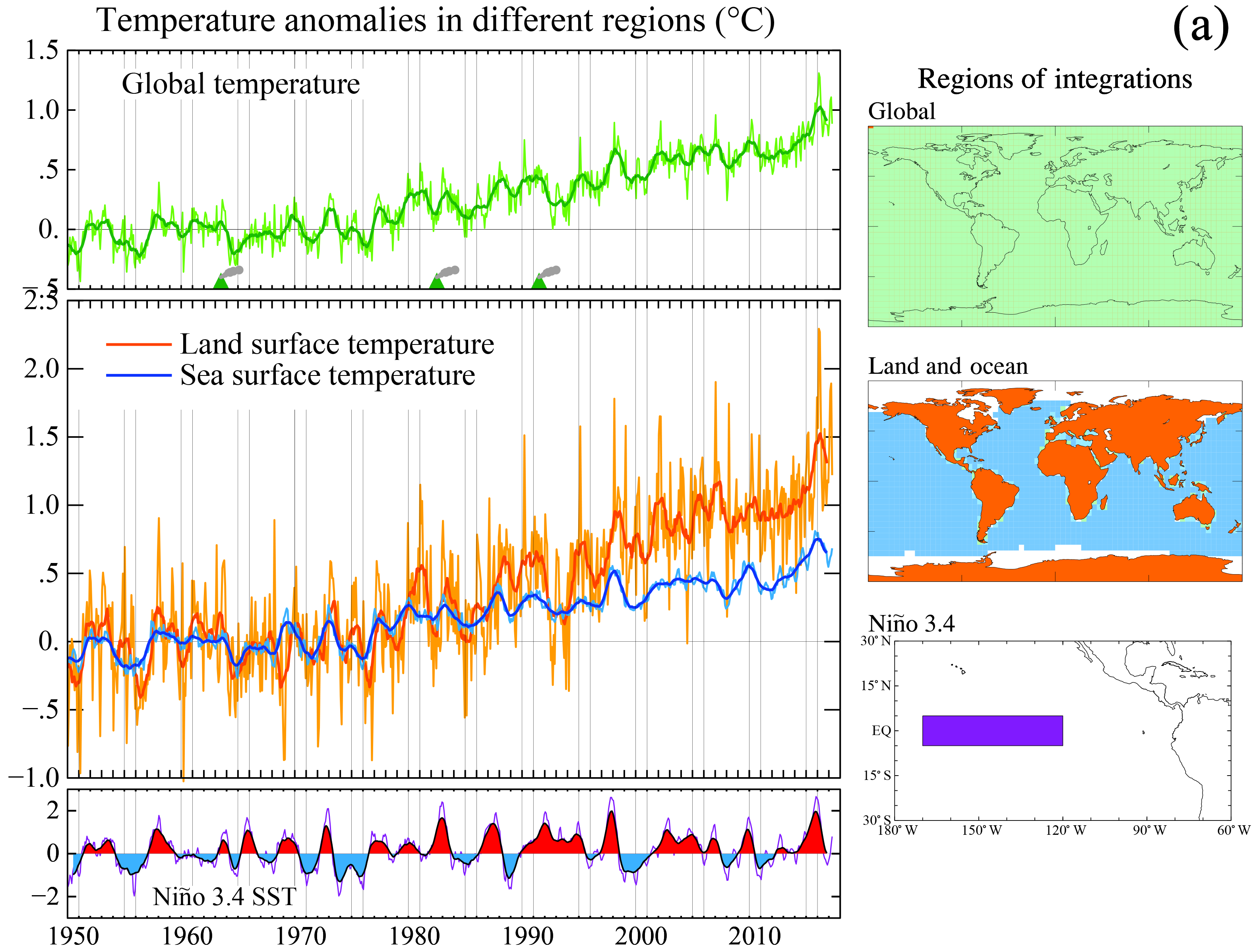
(Hansen et al. 2017, License: cc-by)
- Login to post comments
- Weiterlesen
Trajectories of Carbon from Tokyo
Mo, 07/03/2017 - 21:04 — Draketocouldn’t resist this one ☺
I was only plotting trajectories of carbon dioxide from Tokyo, when this came up:

How it began:

Cthulhu fhtagn!
- Login to post comments
- Weiterlesen
Unwanted pregnancy hits at random
Fr, 06/23/2017 - 21:48 — DraketoIf you do not want to have a child right now, but you want to have a fulfilled heterosexual sex-life, pregnancy is a risk which can hit anyone, however careful he or she is to avoid it. This is an answer I gave someone who equated unintentional pregnancy with questionable morals.
According to "How effective are condoms against pregnancy?":
If you use condoms perfectly every single time you have sex, they’re 98% effective at preventing pregnancy. But people aren’t perfect, so in real life condoms are about 82% effective — that means about 18 out of 100 people who use condoms as their only birth control method will get pregnant each year.
Other means of birth control are around 70-91% effective, with the sole exception of the implant which has 99% effectiveness, so even if people are perfectly hygienic and careful, there will be many pregnancies: if you are perfectly hygienic and careful for 10 years, there will be around one pregnancy per couple (on average).
- Login to post comments
- Weiterlesen
IRC-chat via Tor with Emacs on Gentoo
So, 06/11/2017 - 20:02 — DraketoAs example: Connecting to #youbroketheinternet.
emerge privoxy torsocks net-vpn/tor
# rc-config start privoxy tor
# rc-update add privoxy default
# rc-update add tor default
mkdir -p ~/.local/EMACS_TOR_HOME/.emacs.d
echo "(require 'socks)" >> ~/.local/EMACS_TOR_HOME/.emacs.d/init.el
HOME=~/.local/EMACS_TOR_HOME torify emacs --title "Emacs-torified"
# M-x customize-variable RET socks-server RET
#   host: localhost
#   port: 9050
#   type: Socks v5
#   (C-x C-s to save and set)
# M-x erc-select
#   server loupsycedyglgamf.onion
#   port 67
# the welcome channel is good to go.
- Login to post comments
- Weiterlesen
propagating changes; comment on "Time To Rethink Retractions And Corrections?"
Di, 06/06/2017 - 08:48 — DraketoA comment on Amending Published Articles: Time To Rethink Retractions And Corrections? (doi: 10.1101/118356) which asks for making it easier and less of a matter of guilt to change published articles.
Update: Leonid Schneider from forbetterscience notes that there’s a whole dungeon of misconduct which might be facilitated by “living papers”. We need investigate problems in depth before changing established processes. Scientific communication is a complex process. Publication is an important part of it.
Firstoff: The underlying problem which makes it so hard to differenciate between honest errors and fraud is that publications are kind of a currency in science.
- Login to post comments
- Weiterlesen
Strengths and weaknesses of Python
Di, 06/06/2017 - 07:49 — Draketoa reply I wrote on quora.
Python is easy to learn and low ceremony. Both are pretty hard targets to hit. It also has great libraries for scientific work, for system scripting and for web development — and for most everything else. And it is pragmatic in a sense: It gets stuff done. And in a way which others can typically understand easily. Which is an even harder target to hit, especially with low ceremony languages.
- Login to post comments
- Weiterlesen
minimal Python script
Di, 06/06/2017 - 07:41 — DraketoOver the years I found a few things which in my opinion are essential for any Python script:
- A description,
- useful logging
- argument parsing and
- doctests
Everything in this setup is low-overhead and available from Python 2.6 to 3.x, so you can use it to start any kind of project.
- Login to post comments
- Weiterlesen
You can train to become really, really good in almost anything you decide to do.
Di, 05/23/2017 - 16:42 — DraketoShould you do what you’re good at, or rather do what you love? Should you use your talents or follow your passion?
To answer this question, let’s look at actual research instead of gut feeling.1 Is a talent how good you are at doing something? Then it is a function of training time. Is it how fast you move forward? Then you likely already learned from other tasks many of the things you need for your task at hand.
-
The Role of Deliberate Practice in the Acquisition of Expert Performance, K. Anders Ericsson, Ralf Th. Krampe, and Clemens Tesch-Romer, Psychological Review, 1993 ↩
- Login to post comments
- Weiterlesen
arctic unraveling
Mi, 05/17/2017 - 06:43 — DraketoReport: Arctic Is Unraveling, discusses assessment Snow, Water, Ice and Permafrost, notes the article rising tide — sounds more like Hansen was right.
- Login to post comments
- Weiterlesen
Distributed censorship-resistant Wikipedia
Di, 05/16/2017 - 06:08 — DraketoThanks to doublec, there are now distributed censorship-resistant Wikipedia mirrors in Freenet: Distributed Wikipedia Mirrors in Freenet
The current largest mirror is the Simple English Wikipedia (the obvious choice to fight censorship worldwide: it is readable with basic english skills).
With this mirror, information from Wikipedia can be accessed in high-censorship countries:
freenet:USK@m79AuzYDr-PLZ9kVaRhrgza45joVCrQmU9Er7ikdeRI,1mtRcpsTNBiIHOtPRLiJKDb1Al4sJn4ulKcZC5qHrFQ,AQACAAE/simple-wikipedia/0/
- Login to post comments
- Weiterlesen
- 1
- 2
- 3
- 4
- 5
- 6
- 7
- 8
- 9
- nächste Seite ›
- letzte Seite »

Diese Seite nutzt Cookies. Und Bilder. Manchmal auch Text. Eins davon muss ich wohl erwähnen — sagen die meisten anderen, und ich habe grade keine Zeit, Rechtstexte dazu zu lesen…
